Anchord AI - Entity Resolution & Agent Integration
Integrated AI-agent workflows with 11 MCP tools and implemented a reviewable entity-resolution path from candidate matching to safe downstream writes.
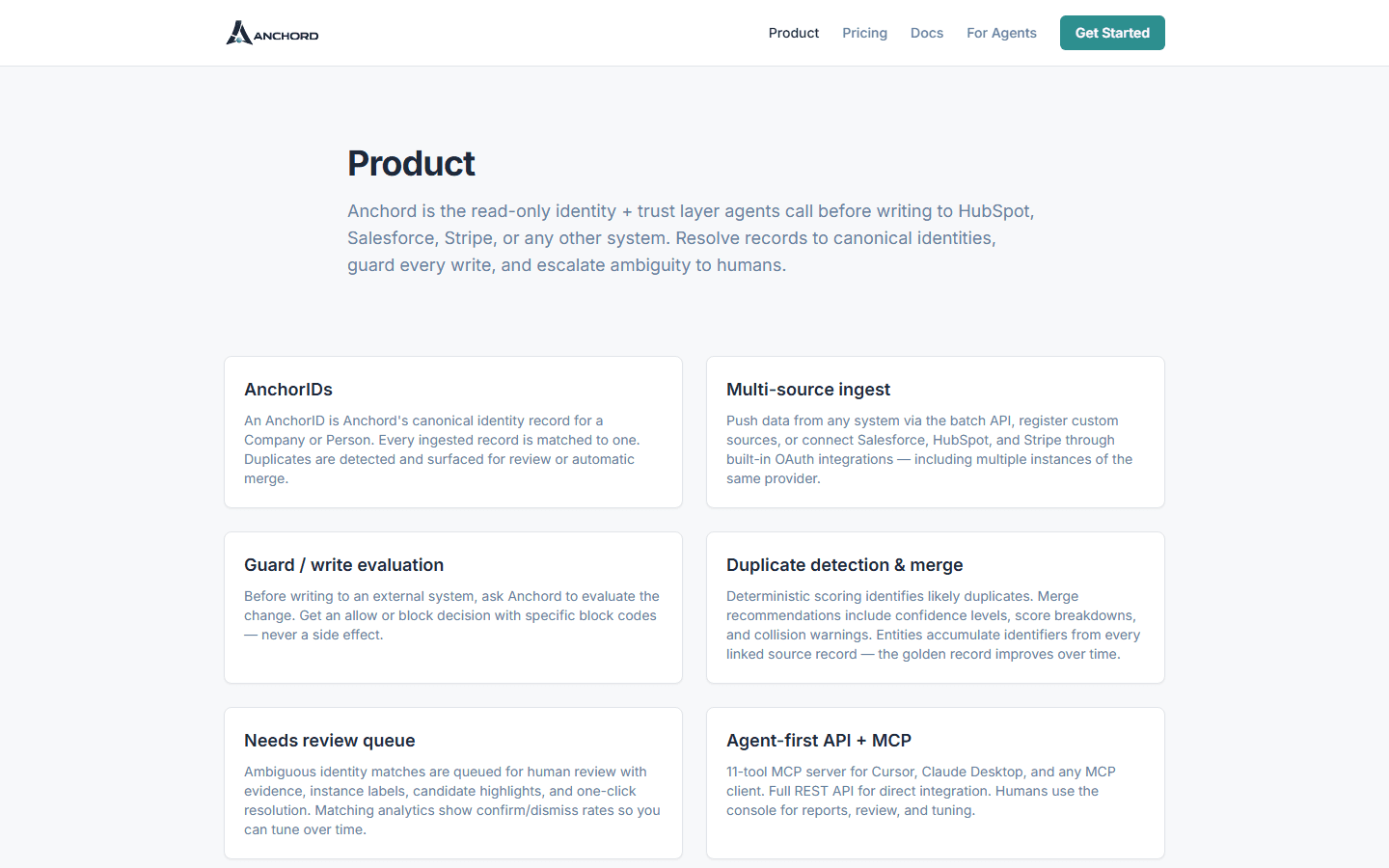
- MCP tools integrated into agent workflows
- 11MCP tools integrated into agent workflows
- Rules-based candidate scoring
- Multi-signalRules-based candidate scoring
- Canonical identity before downstream writes
- Resolve firstCanonical identity before downstream writes
Anchord AI connects agents to business data and helps determine whether records from different sources describe the same company or contact. Tijani's documented work centered on the tool and integration layer and the resolution workflow: MCP tools, REST APIs, webhooks, multi-signal scoring, evidence-backed review, canonical IDs, and resolve-before-write behavior.
The problem
Business records are often duplicated, incomplete, or represented differently across systems. An agent needs more than a fuzzy name match: it needs a repeatable way to score candidate records, expose the evidence behind uncertain matches, and avoid writing against an entity before its identity is resolved.
Engineering constraints
- The workflow uses multiple signals and rules rather than relying on a single matching field.
- Ambiguous candidates require evidence-backed review instead of being silently treated as confirmed matches.
- Downstream writes must follow entity resolution, not precede it.
Tijani's role
Tijani integrated AI-agent workflows with 11 MCP tools, REST APIs, and webhooks. He implemented the multi-signal, rules-based scoring path, the evidence-backed review of ambiguous matches, canonical entity identifiers, and resolve-before-write flows.
- Connected the agent workflow to business capabilities through MCP tools and service APIs.
- Implemented scoring that combines more than one signal and applies explicit rules to candidate matches.
- Made uncertain matches reviewable with supporting evidence and stable canonical IDs.
- Kept entity resolution ahead of downstream writes so the workflow does not mutate a record on an unresolved assumption.
Resolution and write sequence
The workflow separates candidate discovery from the decision to treat two records as the same entity. A candidate can be scored, reviewed with its supporting evidence, and mapped to a canonical identifier. Only after resolution does the connected workflow proceed to a write operation.
- Multi-signal and rules-based candidate scoring.
- Evidence-backed review for ambiguous matches.
- Canonical entity IDs for consistent downstream references.
- Resolve-before-write sequencing for connected agent actions.
Integration surface
The project work connected agent behavior to external business systems using MCP tools, REST APIs, and webhooks. The supplied materials do not identify a specific programming language or database for this engagement, so this case study keeps the technology description to the integration mechanisms that were documented.
Technologies & implementation areas
- AI Agents
- MCP
- REST APIs
- Webhooks
- Entity Resolution
- Rules-Based Scoring
Role & ownership
Tijani participated in developing and deploying Anchord AI's agent integration and entity-resolution workflows, including the 11-tool MCP integration, scoring, evidence review, canonical IDs, and resolve-before-write sequence. This describes his contribution within the wider product team.